
Introduction
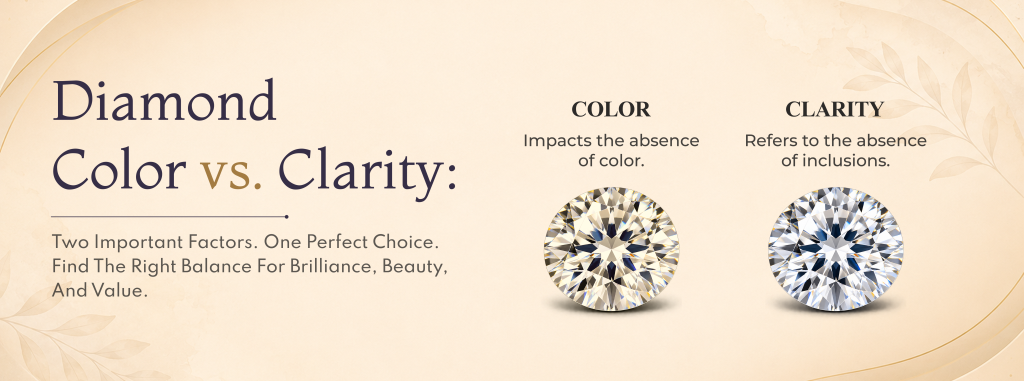
Color and clarity are two of the most discussed diamond quality factors, and both can influence beauty and price. The challenge is that they affect a diamond in very different ways. Color describes how much visible body tint a diamond has, while clarity describes internal inclusions and surface blemishes. For many shoppers, the smartest choice is not simply to buy the highest grade in both categories. It is to understand which differences you can actually see once the diamond is set and worn.
This guide explains diamond color and clarity side by side, shows when one may deserve more of your budget, and offers practical starting points based on shape, carat size, and metal color.
Diamond Color vs. Clarity at a Glance
| Factor | Diamond Color | Diamond Clarity |
| What it describes | The degree of colorlessness, typically graded from D to Z for diamonds in the normal color range. | The relative absence of inclusions and blemishes, graded from FL through I3. |
| What you may notice | Warmth or yellow/brown tint, especially in larger stones and open-facet shapes. | Individual inclusions if they are large, dark, centrally located, or present in lower clarity grades. |
| What affects visibility | Shape, carat size, lighting, and setting metal. | Shape, carat size, inclusion type, size, number, relief, and location. |
| Value strategy | Near-colorless grades often provide a white appearance without the premium of top colorless grades. | Eye-clean VS2 or SI1 stones often provide strong visual value when inclusions are not visible face-up. |
What Is Diamond Color?

For diamonds in the standard color range, color grading is really a measure of how little yellow, brown, or gray body color is present. The GIA D-to-Z scale begins at D, the most colorless grade, and progresses toward increasingly noticeable color at Z. Adjacent grades can be extremely subtle, which is why a diamond does not need a D grade to look bright and white in everyday wear.
Colorless: D, E, and F
D-F diamonds sit at the top of the normal color scale. They are prized for rarity and a crisp, icy appearance, particularly in white gold or platinum settings. The visual difference between D, E, and F is usually very small to an untrained eye, so much of the price premium reflects rarity rather than a dramatic everyday appearance difference.
Near-Colorless: G, H, I, and J
G-J is a popular range for shoppers who want a diamond that appears white while keeping more of the budget available for carat weight, cut quality, or the setting. G and H generally look very white in most settings. I and J can show mild warmth in some stones, but that warmth may be less noticeable in yellow or rose gold.
What Is Diamond Clarity?
Diamond clarity refers to the relative absence of internal inclusions and external blemishes. GIA clarity grades are determined under 10x magnification and consider characteristics such as their size, nature, number, relief, and position. The clarity scale contains 11 grades, from Flawless (FL) through Included (I3).
For an everyday buyer, the most useful question is often not whether a diamond is technically flawless under magnification, but whether it appears clean to the naked eye. This is commonly described as being “eye-clean.”

Clarity Grade Overview
| Grade Range | General Description | Typical Naked-Eye Appearance | Buying Note |
| FL-IF | No inclusions visible, or no internal inclusions, at 10x. | Completely clean to the eye. | Extremely rare; often purchased for rarity or prestige rather than a visible everyday advantage. |
| VVS1-VVS2 | Minute inclusions that are very difficult to locate at 10x. | Eye-clean. | Exceptional clarity, but the difference from lower eye-clean grades is generally invisible without magnification. |
| VS1-VS2 | Minor inclusions visible to a trained grader at 10x. | Usually eye-clean. | A strong balance of high clarity and practical appearance. |
| SI1-SI2 | Noticeable inclusions at 10x. | SI1 is often eye-clean; SI2 varies significantly. | Inspect the individual diamond carefully because inclusion type and location matter. |
| I1-I3 | Obvious inclusions at 10x. | Often visible without magnification. | May affect transparency, brilliance, or durability depending on the stone. |
Color vs. Clarity: Which Matters More?
For many diamonds, color is easier to notice than small clarity differences. A faint warm tint can remain visible in normal lighting, while inclusions in an eye-clean diamond may disappear completely at normal viewing distance. That does not mean color is always more important. Step cuts, large diamonds, and stones with centrally placed inclusions can make clarity more significant.
A better rule is: spend enough on clarity to get a visually clean diamond, then decide how much colorlessness matters for your preferred shape, metal, and budget.
How Diamond Shape Changes Color and Clarity
Brilliant-Cut Shapes
Round, oval, pear, cushion, radiant, marquise, princess, and heart shapes use many facets to create flashes of light. This sparkle can help disguise both mild warmth and small inclusions. As a result, shoppers often have more flexibility to choose value-oriented color and clarity grades in brilliant-style cuts.
Step-Cut Shapes
Emerald and Asscher diamonds use long, open facets that produce broad flashes rather than a splintery sparkle. Their transparent “hall-of-mirrors” appearance tends to reveal body color and inclusions more readily, so many buyers choose a somewhat higher color and clarity threshold for these shapes.
How the Setting Metal Affects Diamond Color
Platinum and White Gold
Cool white metals can make a diamond’s body color easier to compare because they do not add warmth around the stone. If you are sensitive to even slight yellow tones, choosing a higher color grade may be worthwhile in a white-metal solitaire or minimal setting.
Yellow Gold and Rose Gold
Warm metals naturally reflect warm tones near the diamond. This can make modest warmth in an I or J diamond feel more harmonious and less noticeable, allowing some buyers to lower the color grade without sacrificing the overall look.
Halos and Side Stones
When a center stone is surrounded by smaller diamonds, the color relationship between the center and accent stones matters. A center diamond that is much warmer than bright white side stones may show greater contrast. Keeping the accent stones reasonably close in apparent color creates a more cohesive result.
How to Tell if a Diamond Is Eye-Clean
- View the diamond face-up at normal viewing distance, not only under extreme magnification.
- Use high-resolution or 360-degree imagery to locate dark or central inclusions.
- Check the grading report for inclusion type and placement.
- Pay extra attention to inclusions near corners or edges if they could affect durability.
- Compare more than one diamond within the same clarity grade because SI and even VS stones can vary.
When to Prioritize Color
- You are choosing a larger diamond where warmth may be easier to notice.
- You prefer a crisp, icy-white appearance.
- The diamond will be set in platinum or white gold.
- You are buying an emerald or Asscher cut, where body color is more visible.
- The clarity grade you are considering is already eye-clean.
When to Prioritize Clarity
- You are choosing an emerald or Asscher cut with open facets.
- A visible inclusion sits near the center of the diamond.
- The diamond is large enough that inclusions are more noticeable.
- The inclusion affects transparency or potentially durability.
- You are comfortable with a little warmth but want a very clean-looking stone.
Smart Buying Tips
- Prioritize cut quality first. A well-cut diamond generally has more life and brilliance than a poorly cut stone with higher color or clarity grades.
- Compare diamonds in the same shape and carat range so you are making a fair visual comparison.
- Do not pay for clarity you cannot see unless rarity or grading prestige is personally important to you.
- Use the setting metal strategically: warm metals can make lower color grades more forgiving.
- Inspect the individual diamond, especially in SI1 and SI2 clarity, rather than choosing by grade alone.
- Review an independent grading report from a respected laboratory before purchasing.
Frequently Asked Questions
Often, color differences are easier to notice than differences between two eye-clean clarity grades. However, clarity may matter more in step-cut or larger diamonds. The best priority depends on the specific stone.
VS2 and SI1 are popular value ranges because many diamonds in these grades appear clean to the naked eye while costing less than VVS or flawless grades. SI1 stones should still be evaluated individually.
G and H are widely chosen for a near-colorless look. I and J can also offer strong value, particularly in yellow or rose gold and in brilliant-cut shapes.
White gold does not make a diamond more yellow, but its cool white tone can create a stronger contrast with a warmer diamond, making body color easier to notice.
Yes. Many SI1 diamonds are eye-clean, but inclusion type, placement, shape, and carat size all matter. Review the actual stone rather than relying only on the grade.
Often, yes. Their broad, open facets reveal inclusions more easily than brilliant cuts, so many shoppers prefer VS2 or better, depending on the individual diamond.
